
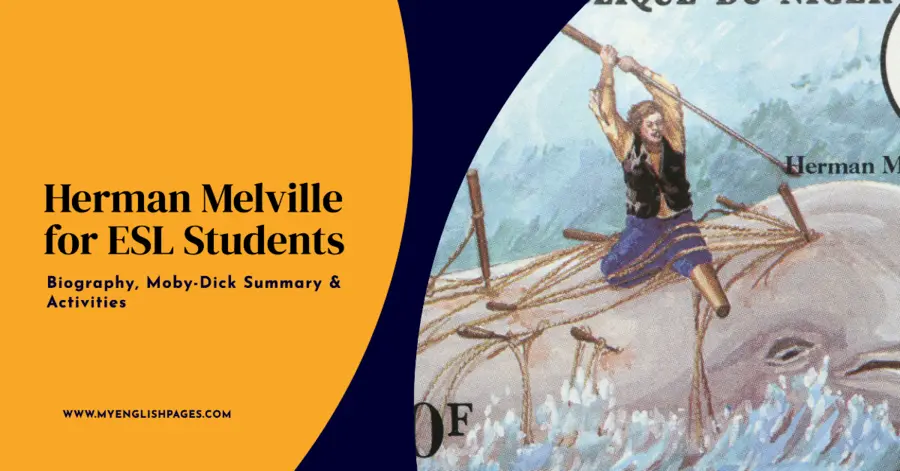
EFL and ESL Materials and Topics – Herman Melville for ESL Students
Table of Contents
Herman Melville
Herman Melville was an American novelist, short-story writer, and poet, best known for his timeless sea adventure Moby-Dick. His writing explores themes of courage, morality, and the conflict between man and nature. This page introduces English learners to Melville’s life, works, and legacy through engaging reading and language activities.
A Concise Biography

Herman Melville was born in 1819 in New York City. Before becoming a writer, he worked as a sailor, an experience that deeply influenced his novels. His best-known work, Moby-Dick, was first published in 1851 but became popular only after his death.
→ Read a short biography of Herman Melville to learn more about his early life, career, and literary legacy.
Interesting Facts About Herman Melville
💡What You May Not Know about Herman Melville
- Melville once worked on a whaling ship that inspired the story of Moby-Dick.
- He was friends with Nathaniel Hawthorne, another famous American author.
- Although Moby-Dick is now considered a masterpiece, it was a commercial failure during his lifetime.
- He also wrote poetry, especially later in life, after his novels received little attention.
- Melville’s face appeared on a U.S. postage stamp in 1984 to honor his literary contributions.
Herman Melville’s Most Famous Books
- Moby-Dick – The story of Captain Ahab’s obsessive quest to hunt the white whale.
- Typee – A semi-autobiographical adventure about Melville’s time in the South Pacific.
- Billy Budd, Sailor – A posthumously published novella about innocence and justice at sea.
- Omoo – A continuation of Typee, describing further adventures in Polynesia.
Moby-Dick Summary (for ESL Students)
Moby-Dick is a novel by Herman Melville about Captain Ahab, the captain of a whaling ship called the Pequod. Ahab is obsessed with hunting Moby Dick, a giant white whale that once injured him. The story is told by Ishmael, a young sailor who joins the voyage.
As the crew sails across the oceans, they face storms, danger, and moral questions about revenge and fate. In the end, Ahab’s obsession leads to tragedy when the whale destroys the ship, and only Ishmael survives to tell the tale.

Activities About Herman Melville for ESL Students
Teachers can use Melville’s works to develop reading, vocabulary, and discussion skills:
- Reading comprehension: Summarize a short passage from Moby-Dick.
- Vocabulary practice: Learn sea-related words (e.g., harpoon, mast, voyage, storm).
- Discussion questions:
- Why do you think Captain Ahab wanted to hunt the whale so badly?
- What can we learn about courage and obsession from Moby-Dick?
- Creative writing: Write a short diary entry from a sailor’s point of view.
- Listening activity: Listen to a whale song and describe what you imagine.
Related Pages
- Short Biography of Herman Melville – A simplified text about his life, career, and literary achievements.
- Moby Dick – Reading and comprehension activities based on his most famous novel.
- Literature – Explore other classic writers and literary terms for English learners.
- Quotes by Herman Melville – Learn English through inspirational and famous quotes.
- Whales – Vocabulary and reading exercises about whales, inspired by Moby-Dick.
- Do Whales Sleep? – A science-based reading text for ESL students.
- Whale Oil – Learn about historical whaling and its impact on society.
- Whale Song – A fascinating text and listening practice on whale communication.
- Classification of Whales – Vocabulary and comprehension practice about animal classification.
More EFL And ESL Materials Here
External Resource
- For more information about Herman Melville’s works and life, visit the official Herman Melville Society website — a rich resource for educators, students, and literature enthusiasts.
- Britannica: Herman Melville – Books, Facts, & Biography