
Table of Contents
Introduction
Learning about American political parties and presidential elections is not only important for understanding U.S. culture and history but also a great way to practice English. For ESL and EFL students, political topics provide rich vocabulary, opportunities for debate, and engaging class discussions.
This page offers links and ideas about the two main U.S. political parties. It also introduces some minor parties and suggests classroom activities to make learning interactive and fun.
Quick Background: American Political Parties
- Since the 1860s, the United States has been dominated by two major political parties:
- The Democratic Party
- The Republican Party
- Other smaller parties, often called “third parties”, include:
- The Libertarian Party
- The Green Party
- The Constitution Party
While the minor parties rarely win major elections, they influence debates and bring attention to specific issues.
→ More on political parties in the USA
Donkey & Elephant: Symbols of the Two Major Parties
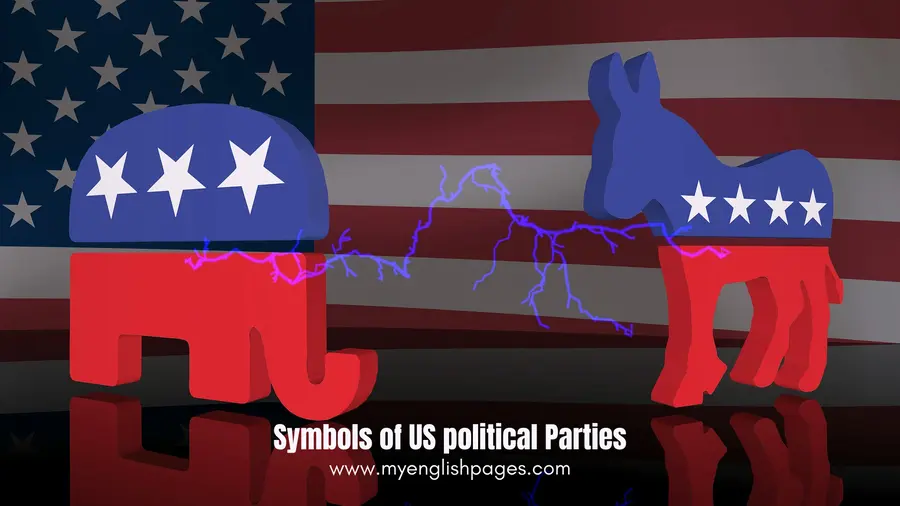
In American politics, symbols play an important role in helping people recognize political parties quickly.
- The Donkey (Democratic Party)
- The Democratic Party is often represented by a donkey.
- The symbol first appeared in the 19th century when critics of Andrew Jackson (a Democratic president) called him a “jackass.” Instead of rejecting the image, Jackson embraced it, and over time, the donkey became a proud symbol of the Democratic Party.
- Today, the donkey represents hard work, humility, and determination.
- The Elephant (Republican Party)
- The Republican Party is represented by an elephant.
- The symbol became popular after a cartoon by Thomas Nast in Harper’s Weekly (1874) showed an elephant to represent Republican voters.
- The elephant is seen as a symbol of strength, dignity, and stability.
→ More about the origin of donkeys and elephants as symbols of democrats and republicans
US Political Parties Activities for Students
Here are some engaging classroom activities ESL teachers can use to help students learn about American political parties and presidential elections:
1. Political Party Matching Game
Objective: Learn the main US political parties and their basic principles.
- Preparation: Write the names of major and minor parties (Democratic, Republican, Green, Libertarian, Constitution) on one set of cards and their key values on another set.
- Activity: Students work in pairs or small groups to match the party with its values. For example:
- Democratic Party → supports social programs, healthcare, diversity, and environmental protection
- Republican Party → emphasizes individual freedom, limited government, and strong defense
- Variation: Turn it into a timed competition. The fastest team to match correctly wins.
- Language Focus: Vocabulary building (government, equality, freedom, economy).
→ US political parties’ activities
2. Role-Play a Presidential Debate
Objective: Practice persuasive speaking and debating skills.
- Preparation: Divide the class into groups. Assign each group a party (Democrats, Republicans, Greens, Libertarians). Give them simplified descriptions of party positions.
- Activity: Each group prepares a short statement on an issue (education, healthcare, economy, environment). Then hold a debate where groups present their views and respond to others.
- Language Focus: Useful debate expressions (I believe…, In my opinion…, On the other hand…).
- Follow-up: The rest of the class votes on the most convincing argument.
3. Election Simulation
Objective: Understand how US presidential elections work while practicing voting-related vocabulary.
- Preparation: Create simple ballots with candidates from two or more parties.
- Activity: Students campaign in small groups by giving a short speech or creating a poster. Then, hold a class vote.
- Language Focus: Writing slogans, persuasive speaking, using modal verbs (should, must, can).
- Follow-up: Count votes together and discuss why people voted the way they did.
4. Political Vocabulary Quiz or Crossword
Objective: Reinforce political and election-related vocabulary.
- Preparation: Make a crossword or word search with words like ballot, candidate, campaign, democracy, constitution, freedom.
- Activity: Students complete the puzzle individually or in teams.
- Language Focus: Word recognition, spelling, and pronunciation practice.
- Extension: Ask students to use each new word in a sentence about politics.
5. Analyzing Political Cartoons
Objective: Build critical thinking and interpretation skills while discussing US culture.
- Preparation: Select simple, age-appropriate political cartoons about elections or parties.
- Activity: Students work in pairs to describe what they see and explain the message.
- Language Focus: Descriptive language (In this cartoon, we see… It suggests that…).
- Follow-up: Compare political humor in the US with their home country.
6. Quotes About Politics – Discussion Activity
Objective: Encourage opinion-sharing and discussion.
- Preparation: Select a few famous quotes about democracy and politics (e.g., Abraham Lincoln, Franklin D. Roosevelt, John F. Kennedy).
- Activity: Students read the quotes and discuss in groups: Do you agree or disagree? Why?
- Language Focus: Expressing agreement/disagreement (I agree because…, I don’t think so…).
7. Political Party Poster Project
Objective: Practice research, teamwork, and presentation skills.
- Preparation: Assign each group a party. Provide simplified texts or fact sheets.
- Activity: Students create a poster with the party’s symbol, color, values, and famous leaders. Then, groups present to the class.
- Language Focus: Presentation skills (Today we are presenting…, Our party believes…).
👉 These activities not only teach students about American politics but also develop key language skills: vocabulary, speaking, reading, and writing. They are flexible—you can adapt them for beginner, intermediate, or advanced learners.
Here are more ideas to try in your classroom
Additional Topics to Explore
If you want to extend the lesson, here are related topics for English learners:
- Political Parties and the Presidential Election – Learn about the American political parties
- US political parties’ activities – Test your knowledge about US political parties
- American government – branches and responsibilities
- Quotes about politics – for discussion and vocabulary practice
- Jokes about politics – for humor and idioms
- Fact sheet about the USA – quick cultural overview
- American geography and history – context for elections
- American economy and culture – important issues in politics
- The American educational system – often debated in politics
- Famous U.S. attractions – for cultural enrichment

Conclusion
Teaching about U.S. political parties and presidential elections provides students with more than just cultural knowledge—it helps them practice their English speaking, reading, and writing skills in a meaningful context. Using activities like debates, role-plays, and quizzes, students can build vocabulary, express opinions, and understand democracy in action.