

Reading Comprehension: Christopher Marlowe Biography
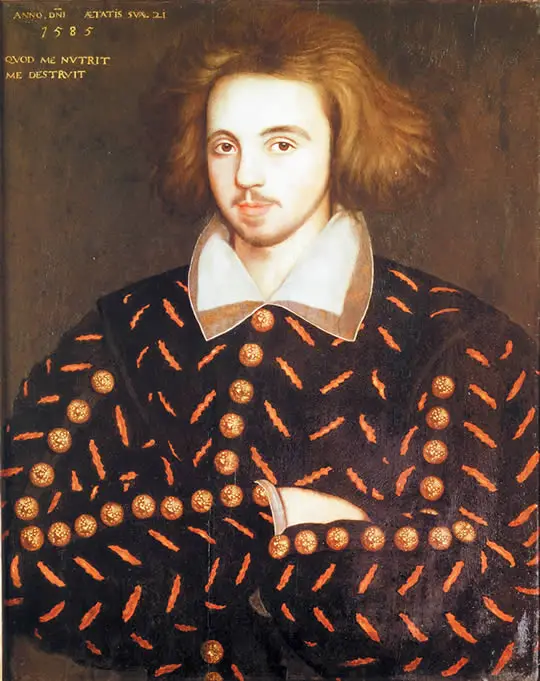
Develop your reading skills. Read the following text about Christopher Marlowe and do the comprehension questions
Christopher Marlowe: A Literary Enigma of the Elizabethan Era
Christopher Marlowe, an illustrious figure of the Elizabethan era, stands as a titan of English literature despite his tragically brief life. Born in 1564 in Canterbury, England, Marlowe’s brilliance as a playwright, poet, and translator shone brightly before his untimely demise at the tender age of twenty-nine. Although his theatrical career spanned merely six years, his profound impact resonates through the annals of literary history, notably influencing the towering figure of William Shakespeare.
Early Life and Education
Marlowe’s early life unfolded in the quaint streets of Canterbury, where he was raised by his parents, John and Catherine Marlowe. While his exact date of birth remains elusive, historical records indicate his baptism on February 26th, 1564. Scholars posit that Marlowe was likely born a few days prior, establishing him as slightly older than his contemporary, Shakespeare. Marlowe received his education at The King’s School in Canterbury before advancing to Corpus Christi College, Cambridge, where he excelled academically and obtained his Bachelor of Arts degree in 1584.
However, Marlowe’s scholastic journey faced a moment of uncertainty when rumors swirled regarding his purported conversion to Roman Catholicism. These murmurs cast a shadow over his candidacy for a Master of Arts degree, prompting hesitation from the university authorities. Yet, intervention from the Privy Council, lauding Marlowe’s integrity and service to Queen Elizabeth I, quelled the doubts, paving the way for the conferral of his master’s degree.
Marlowe’s Enigmatic Allegiance
The enigmatic nature of Marlowe’s allegiance to the crown remains a subject of scholarly debate and conjecture. Some biographers contend that Marlowe’s frequent absences from university and the intervention of the Privy Council hint at his involvement in clandestine activities, possibly as a covert operative for Sir Francis Walsingham’s intelligence service. While tangible evidence eludes historians, the notion persists, adding layers to Marlowe’s enigmatic persona.
Literary Legacy
Marlowe’s literary prowess blossomed amidst the backdrop of political intrigue and artistic fervor in Elizabethan England. Despite his abbreviated lifespan, he penned a remarkable array of plays characterized by their bold themes, intricate characters, and masterful employment of blank verse. Marlowe’s oeuvre includes seminal works such as “Tamburlaine the Great,” “The Jew of Malta,” and “Edward II,” each contributing to the burgeoning landscape of English drama.
However, it is Marlowe’s magnum opus, “The Tragicall History of Doctor Faustus,” that etched his name indelibly into the annals of literary acclaim. Adapted from the German Faustbuch, this seminal work explores themes of ambition, knowledge, and the human condition, cementing Marlowe’s reputation as a visionary dramatist.
Tragic Demise
Marlowe’s illustrious career was abruptly truncated by a series of tragic events culminating in his untimely demise. Accused of heresy, Marlowe found himself ensnared in a web of intrigue that ultimately led to his arrest. Strangely, on May 30, 1593, Marlowe met his demise at the hands of Ingram Frizer, under circumstances shrouded in mystery and speculation. The exact motivations behind Marlowe’s demise remain elusive, fueling endless speculation and fascination with the enduring enigma of his life and death.
In retrospect, Christopher Marlowe emerges not only as a luminary of Elizabethan literature but also as a captivating enigma whose life and work continue to captivate scholars and enthusiasts alike, underscoring his enduring legacy in the annals of English literary history.
Source: Wikipedia
Related Pages: