
Table of Contents
Introduction
A 21st-century classroom is more than a space equipped with technology. It is a dynamic learning environment where students collaborate, think critically, communicate effectively, and take an active role in their learning. Instead of memorizing facts, learners solve real-world problems, work in teams, use digital tools, and develop the essential skills they need for modern life and future careers.
This guide explains what a 21st-century classroom is, its key characteristics, the principles behind 21st-century education, and why it matters—especially for English language teachers. You will also find practical tips, classroom activities, and design ideas to help you create an effective, student-centered learning environment.
Defining 21st-Century Education
21st-century education is a student-centered approach that focuses on developing essential skills such as:
- Critical thinking
- Creativity
- Collaboration
- Communication
- Digital literacy
- Adaptability
- Global awareness
Unlike traditional models that rely heavily on memorization and standardized tests, 21st-century education encourages active engagement, problem-solving, creativity, and meaningful communication. Students learn by doing, applying knowledge to real situations and collaborating with peers.
A Brief Historical Context
Traditional education was designed for the industrial age, when classrooms focused on content mastery, rote learning, and teacher-centered instruction. As technology, globalization, and social change reshaped the world, education systems needed to adapt.
The shift toward 21st-century education emerged as a response to:
- Rapid technological advancements
- The growing importance of digital literacy
- Global interconnectedness
- The need for lifelong learning
- The demand for adaptable, creative problem-solvers
Today, modern education values skills over memorization, real-world application over theoretical recall, and learner autonomy over passive listening.
Principles of 21st-Century Education Classrooms
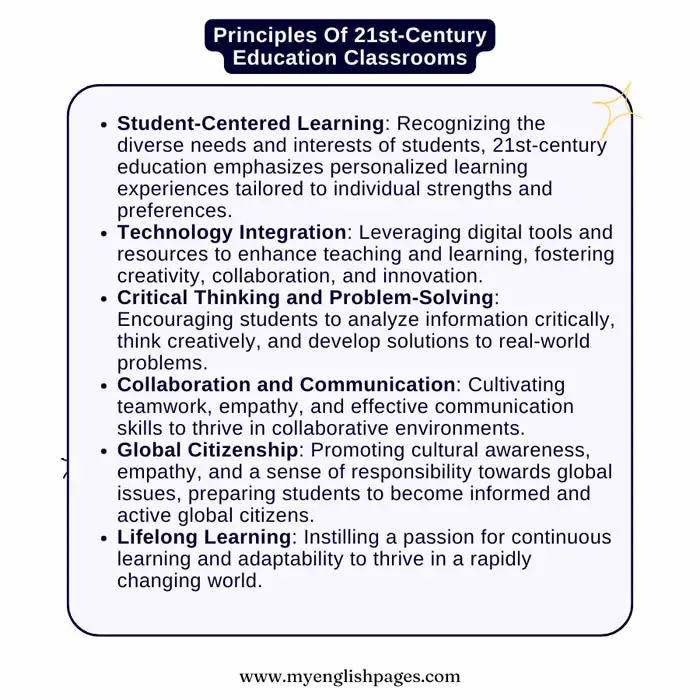
21st-century classrooms are grounded in several key principles:
1. Student-Centered Learning
Learners’ interests, abilities, and needs guide the teaching process. Students take ownership of their learning through choice, inquiry, and active participation.
2. Meaningful Technology Integration
Technology is used to enhance learning—through collaboration tools, research, content creation, and authentic communication—not simply as a digital replacement for textbooks.
3. Critical Thinking and Problem-Solving
Students are encouraged to analyze, evaluate, question, and create. Tasks require higher-order thinking, not just recall.
4. Collaboration and Communication
Students work together to solve problems, share ideas, and present their work. Effective communication—both digital and face-to-face—is essential.
5. Global Citizenship
Learners explore global issues, cultures, and perspectives. They develop empathy, cultural awareness, and a sense of responsibility.
6. Lifelong Learning
Students build habits of curiosity, flexibility, and continuous improvement, preparing them for a world that keeps changing.
Characteristics of a 21st-Century Classroom
Here are the defining features of modern classrooms today.
1. From Teacher-Centered to Student-Centered Learning
Teachers guide instead of lecture. Students explore, experiment, and create their own learning products.
Example (EFL):
Instead of the teacher explaining grammar rules, students analyze real examples and create a mini-poster teaching the rule to their classmates.
2. From Content Coverage to Learning Through Doing
Students learn by completing meaningful tasks and projects connected to real life.
Example:
Instead of learning vocabulary lists, students interview classmates and create a class infographic.
3. From Memorization to Practical Application
Learners apply knowledge to authentic tasks.
Example:
Students write emails, record podcasts, or prepare presentations rather than simply completing worksheets.
4. From Lecturer to Facilitator
The teacher supports inquiry, guides research, and provides feedback while students take the lead.
5. From Whole-Class Instruction to Flexible Grouping
Students work in pairs, groups, or individually, depending on goals and needs. Groups are dynamic and change frequently.
6. From Single to Multiple Learning Modalities
Lessons include visual, auditory, kinesthetic, and digital elements to reach diverse learners.
7. From Single Discipline to Interdisciplinary Learning
Projects integrate skills and content across subjects.
Example:
A project combining English (presentation skills), science (climate topics), and digital skills (slides or videos).
8. From Isolation to Collaboration
Learning is social. Students share ideas, debate, peer-review, and problem-solve together.
9. From Tests to Performance-Based Assessments
Assessment includes projects, portfolios, videos, presentations, and real-world tasks.
10. From Textbook Dependence to Diverse Resources
Students use websites, videos, journals, apps, and expert interviews—not only textbooks.
11. From Technology as a Luxury to Full Integration
Digital tools support research, collaboration, creativity, and communication on a daily basis.
Practical Tips for Educators
- Use technology purposefully (Google Workspace, LMS, Padlet, Canva, Flip).
- Design interdisciplinary projects connecting multiple subjects.
- Promote collaboration through peer feedback and group problem-solving.
- Encourage creativity using storytelling, videos, posters, podcasts, or digital tools.
- Build critical thinking through open-ended questions and inquiry tasks.
- Differentiate instruction to meet individual learning needs.

The 21st-Century Classroom Method
This method focuses on active learning rather than passive listening. Teachers:
- Facilitate inquiry and exploration
- Guide project-based learning
- Encourage student voice and choice
- Integrate digital tools meaningfully
- Promote communication, creativity, and collaboration
21st-Century Classrooms: Design and Activities
Design Principles
A modern classroom is:
- Flexible
- Movable furniture supports collaboration, stations, and group work.
- Technology-Rich
- Smartboards, digital devices, apps, and online platforms enhance learning experiences.
- Inclusive
- Classroom design supports diverse learners and multiple learning styles.
Activities for a 21st-Century Classroom
- 1. Collaborative Discussions
- Use guiding questions, debate formats, or small-group tasks to build communication and critical thinking.
- 2. Project-Based Learning
- Students create real-life products such as posters, videos, presentations, or digital stories.
- 3. Digital Storytelling
- Learners combine images, narration, music, and text to share experiences or explain concepts.
- 4. Collaborative Research Projects
- Groups investigate a topic and present findings using slides, mind maps, or infographics.
- 5. Problem-Solving Challenges
- Students work together to suggest solutions to school or community issues.
Traditional vs. 21st-Century Classrooms
| Aspect | Traditional Classroom | 21st-Century Classroom |
|---|---|---|
| Teacher Role | Teacher-centered, direct instruction | Student-centered facilitator |
| Content | Focus on textbook coverage | Focus on mastery through projects |
| Assessment | Quizzes and tests | Performance-based assessments |
| Learning Modalities | Mostly lectures | Multiple modalities, tech-enhanced |
| Grouping | Whole-class | Flexible, dynamic groups |
| Interdisciplinary Learning | Subjects taught separately | Integrated projects |
| Student Interaction | Mostly individual | Collaborative and interactive |
| Technology | Used sparingly | Fully integrated |
| Resources | Textbook-dependent | Diverse digital and real-world sources |
More resources: 21st-century skills framework
Frequently Asked Questions About 21st-Century Classrooms
What is a 21st-century classroom?
A 21st-century classroom is a student-centered learning environment that focuses on developing essential skills such as critical thinking, collaboration, communication, creativity, and digital literacy. It uses flexible seating, technology, project-based learning, and real-world tasks to prepare learners for modern life and future careers.
What skills are most important for 21st-century learners?
The most commonly recognized 21st-century skills include the 4Cs—critical thinking, communication, collaboration, and creativity—along with digital literacy, global awareness, adaptability, problem-solving, and lifelong learning.
How is a 21st-century classroom different from a traditional classroom?
Traditional classrooms rely heavily on lectures, memorization, and textbook-based instruction.
21st-century classrooms focus on active learning, flexible grouping, technology integration, interdisciplinary projects, and performance-based assessments. Students take a more active role in their learning.
What teaching methods support 21st-century learning?
Effective methods include project-based learning, inquiry-based learning, collaborative tasks, flipped classroom strategies, digital storytelling, problem-solving activities, and personalized learning approaches. Teachers act as facilitators rather than lecturers.
Why is technology important in 21st-century education?
Technology enhances collaboration, research, creativity, and communication. It provides access to diverse resources, supports differentiated instruction, and allows students to produce real-world digital products such as videos, presentations, blogs, and podcasts.
How can teachers integrate technology effectively?
Teachers can use tools like Google Workspace, Padlet, Flip, interactive whiteboards, learning management systems, video creation apps, and online collaboration platforms. Technology should support learning goals—not replace good pedagogy.
What does student-centered learning mean in modern classrooms?
Student-centered learning means students participate actively, make choices, work collaboratively, and take responsibility for their progress. The teacher guides the learning process and provides support, feedback, and structure.
What are some examples of 21st-century classroom activities?
Examples include group discussions, research projects, digital storytelling, collaborative problem-solving tasks, peer teaching, online debates, interdisciplinary projects, and the creation of infographics, podcasts, or short videos.
How can teachers create a flexible learning environment?
Use movable desks, learning stations, beanbags, group tables, and open floor space. Allow students to choose seating that fits the activity—pair work, group work, individual focus tasks, or whole-class discussions.
How do performance-based assessments work?
Instead of relying solely on tests, students demonstrate learning through projects, presentations, portfolios, posters, role-plays, experiments, or digital products. These assessments measure higher-order thinking and real-world application.
Why is collaboration important in 21st-century classrooms?
Collaboration builds communication, problem-solving, social skills, empathy, and teamwork. Modern workplaces value these skills, and collaborative learning mirrors real-life professional environments.
What role does global citizenship play in modern education?
Global citizenship encourages learners to understand diverse cultures, address global issues, communicate across cultures, and develop empathy and responsibility. It prepares them for a connected, multicultural world.
Conclusion
A 21st-century classroom is an active, collaborative, and inclusive learning environment. For English teachers, it means creating opportunities for students to communicate, think critically, solve problems, and use language for real purposes. By embracing these principles and strategies, we help learners become confident, independent, and ready to thrive in an increasingly complex world.