

Table of Contents
Introduction
Education is often seen as the great equalizer, a pathway to opportunity and success for all. Yet, in recent years, a troubling trend has emerged: boys are increasingly lagging behind girls in academic achievement.
From literacy skills to graduation rates, the gap between boys and girls is widening, raising important questions about why this is happening and what we can do to address it.
In this blog post, we’ll explore some of the key reasons behind boys’ struggles in school, reflect on potential solutions, and consider how we can create a more inclusive and effective educational system for all students.
Why Are Boys Falling Behind in School?

In recent years, a concerning trend has emerged in education: boys are increasingly falling behind in school. This isn’t an isolated issue—it’s a widespread pattern. From college enrollment and degree attainment to performance on standardized tests, girls are consistently outperforming boys in many academic areas. While boys tend to excel in STEM subjects, they often lag behind in reading, writing, and verbal skills. Beyond academics, boys also face more disciplinary issues, with higher rates of suspensions and behavioral challenges.
This raises an important question: Why are boys falling behind in school? The reasons are complex, but they point to a need for change in how we approach education. The following sections will explore some of the key factors behind this trend and discuss potential solutions to help boys succeed.
1. The Literacy Gap: A Developmental Divide
One of the most significant factors contributing to boys’ academic challenges is the early emphasis on literacy skills. Research shows that boys, on average, develop reading and writing skills later than girls. Yet, modern educational standards often require these skills to be mastered at increasingly younger ages.
As author Richard Whitmire points out, this mismatch between boys’ developmental timelines and school expectations can set them up for failure from the very beginning. When boys struggle to keep up with early literacy demands, they may become disengaged, frustrated, and labeled as “behind”—a label that can follow them throughout their academic careers.
What Can We Do?
- Allow boys more time to develop literacy skills at their own pace.
- Incorporate hands-on, visual, and kinesthetic learning methods to make literacy more engaging.
- Diversify reading materials to include genres and topics that appeal to boys, such as action, adventure, and non-fiction.
2. The Classroom Environment: A Mismatch for Boys’ Learning Styles
Traditional classroom settings often prioritize sitting still, listening quietly, and following instructions—behaviors that come more naturally to many girls. Boys, on the other hand, tend to thrive in environments that allow for movement, competition, and hands-on exploration.
The lack of male teachers in primary schools (where female teachers dominate) may also play a role. Without diverse teaching perspectives, classroom dynamics and teaching methods may unintentionally favor girls’ learning styles, leaving boys feeling out of place or misunderstood.
What Can We Do?
- Incorporate more active and project-based learning opportunities.
- Encourage more men to enter the teaching profession, particularly in early education.
- Train teachers to recognize and address gender differences in learning styles.
3. Motivation and Engagement: The Content Conundrum
Another critical issue is the lack of motivating content for boys in school curricula. Many boys find the reading materials and topics covered in class uninteresting or irrelevant to their lives. This lack of engagement can lead to disinterest in learning and poor academic performance.
Additionally, the increasing emphasis on quantitatively packed syllabi and high-stakes testing may disadvantage boys, who often struggle with sustained focus and self-discipline in highly structured environments.
What Can We Do?
- Diversify curricula to include more topics that resonate with boys’ interests, such as sports, technology, and science.
- Use competitive games, challenges, and real-world problem-solving activities to motivate boys.
- Balance traditional assessments with alternative methods that allow boys to demonstrate their strengths.
4. Societal Expectations: The Pressure to Conform
Beyond the classroom, societal expectations of masculinity can also hinder boys’ academic success. Boys may feel pressure to conform to stereotypes that prioritize physical strength, toughness, and independence over intellectual curiosity and emotional expression.
This pressure can discourage boys from seeking help, showing vulnerability, or valuing academic achievement. As a result, many boys may disengage from school or adopt a “too cool for school” attitude to fit in with peer expectations.
What Can We Do?
- Redefine masculinity in ways that celebrate academic success, emotional intelligence, and curiosity.
- Provide mentorship programs and positive male role models who exemplify the value of education.
- Create safe spaces for boys to express their struggles and seek support without fear of judgment.
A Call for Balance and Inclusion
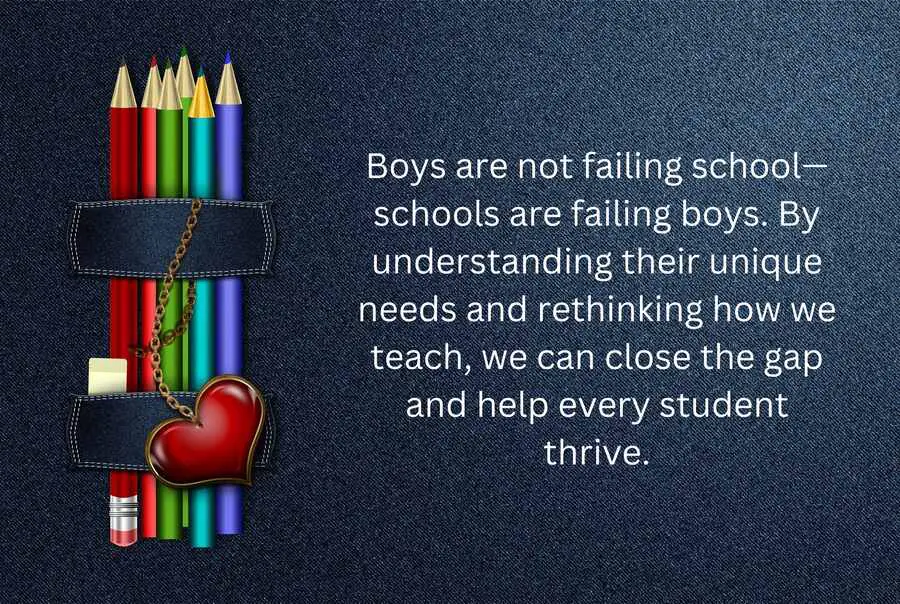
The challenges boys face in school are complex and multifaceted, but they are not insurmountable. By recognizing and addressing the unique needs of boys—whether through tailored teaching methods, diverse reading materials, or a more balanced representation of male teachers—we can create a more inclusive and effective educational system.
At the same time, it’s important to avoid oversimplifying the issue or reinforcing harmful stereotypes. Both boys and girls benefit from an education system that values and supports their individual strengths and challenges.
Final Thoughts
The question of why boys are falling behind in school is not just about boys—it’s about creating a system that works for everyone. By reflecting on these challenges and working together to implement thoughtful solutions, we can ensure that all students, regardless of gender, have the opportunity to thrive in school and beyond.